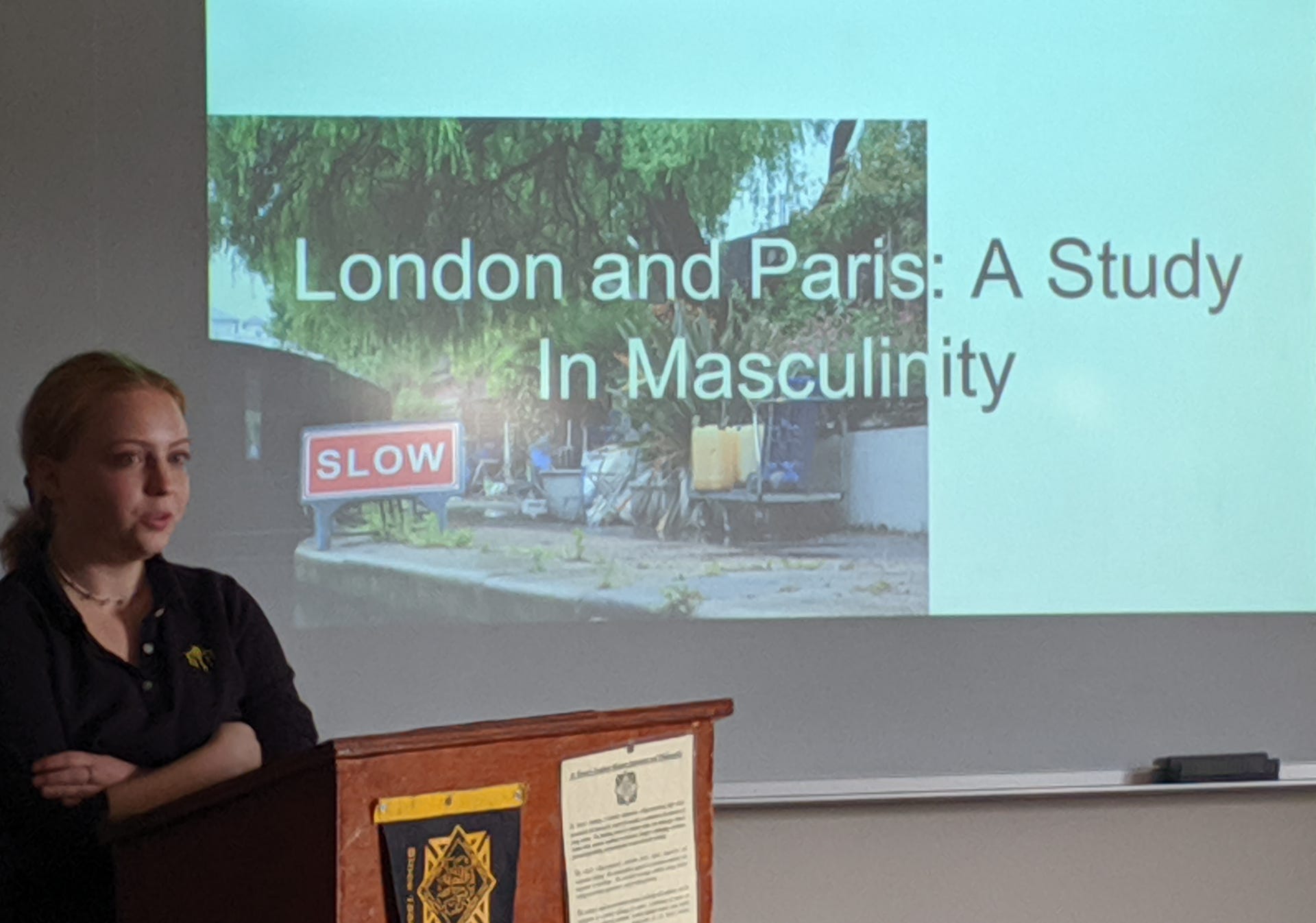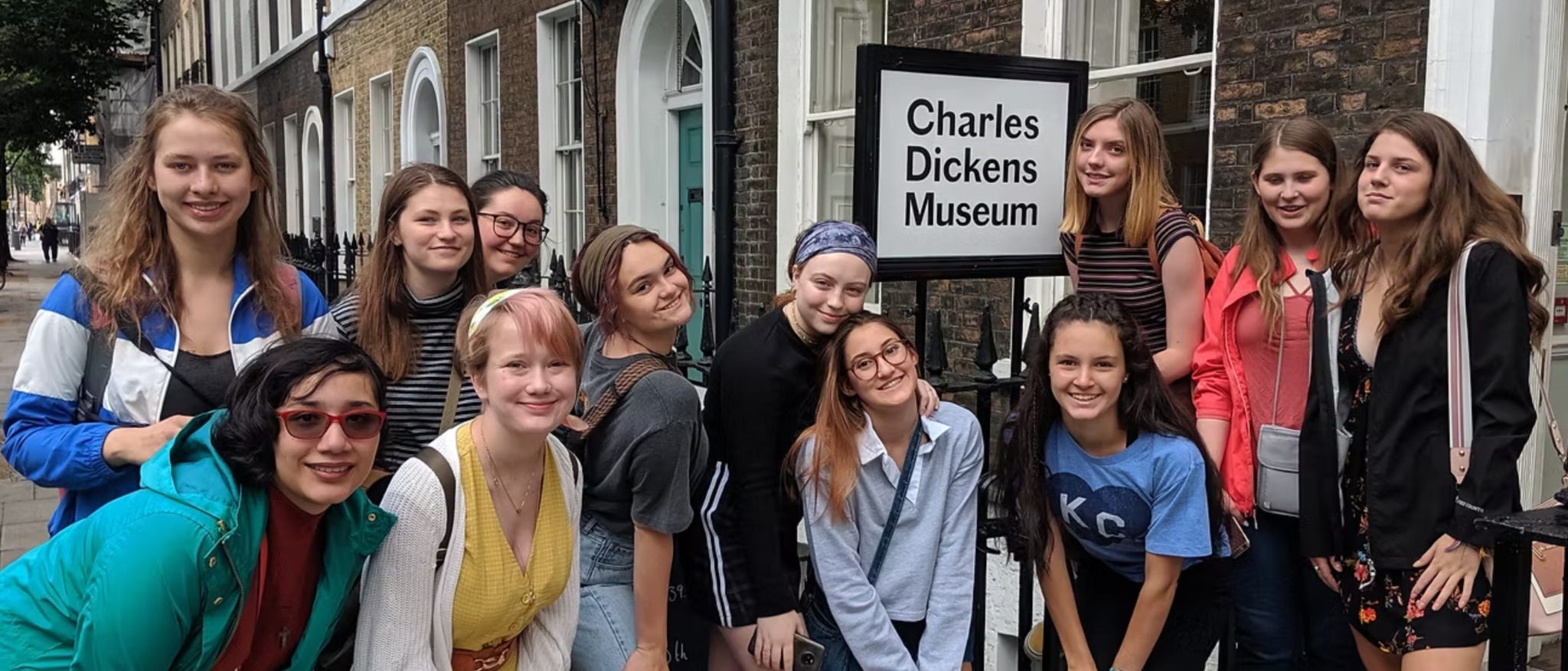
A Study-in-Residence on A Tale of Two Cities, With the Class in Front of the Charles Dickens Museum Before a Full Day Touring the Home, Learning to Interrogate Artifacts from the Museum’s Curator, Contrasting Dickens’ Journalism and Fiction With a Dickens Scholar, Seeing a Professional Actor Perform Dickens’ Personal Scripts, and Having Coffee and Lunch in Dickens’ Private Walled Garden.
Study-in-Residence: Student Travel As A Masterclass
See a Visual and Video Diary of an Entire Class on My Instagram
Before COVID, I spent years developing a model of student travel that dives deeper than the “experiential learning” and “immersive trips” offered by ordinary travel companies:
“Study-in-Residence.”
The idea is simple: Student travel that’s designed as a masterclass. For high school students, we teach students to study abroad before they study abroad in college.
Study-in-Residence is a student trip designed as a course, which explores a philosophical question by deep-diving into a specific piece of literature, historical figure or event, or work of art. Before the trip, the students engage in readings for historical and cultural context, preparing them for experiences on the trip. When we’re there, they will say, “Oh, we read about this!”
The trip is composed of on-site educational and research opportunities with academic and cultural organizations in the place where it happened. These are supplemented by “must-do” and “just-off-the-beaten-path” experiences that immerse students not just in the culture, but the history of the place.
When the students return home, they turn their notes, pictures, videos, and other learnings into a visual essay that answers the philosophical question based on their pre-trip readings, contemporaneous notes from the trip, and post-trip reflections. These visual essays, and the trip experience itself, are ready-made for college applications. Thus, the return on investment is a tangible piece of the college application, along with an experience that teaches them to study abroad before they study abroad.
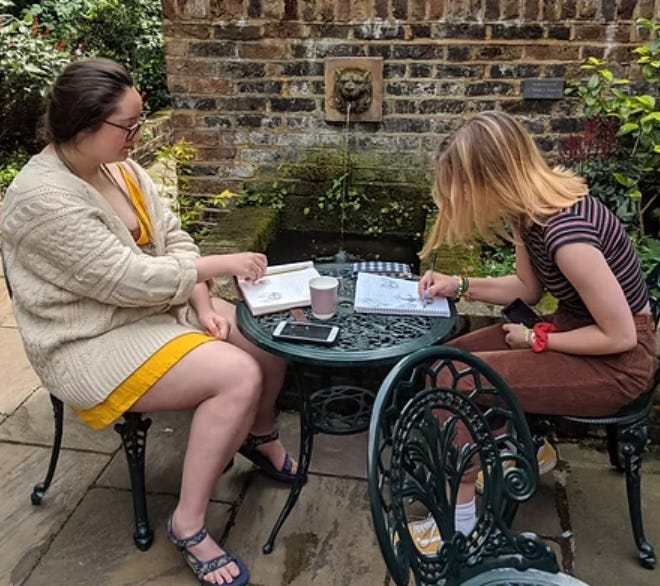
Journaling in Charles Dickens’ Private Garden to Record What We Learned
Study-in-Residence Puts Learning at the Center of the Student Travel Experience
The Study-in-Residence design starts with a subject that’s complex and interesting enough that students will want to spend time really diving into it. Utilizing principles of Place-Based, Experiential, and Project-Based Learning, Study-in-Residence courses are a journey, in all senses of the word, which end with the student creating a work that they can present for teachers, parents, and each other. This is an authentic work that demonstrates research skills, synthesis in critical thinking, executive functioning, collaboration, proactivity, independence–exactly the characteristics colleges screen for in the application process.
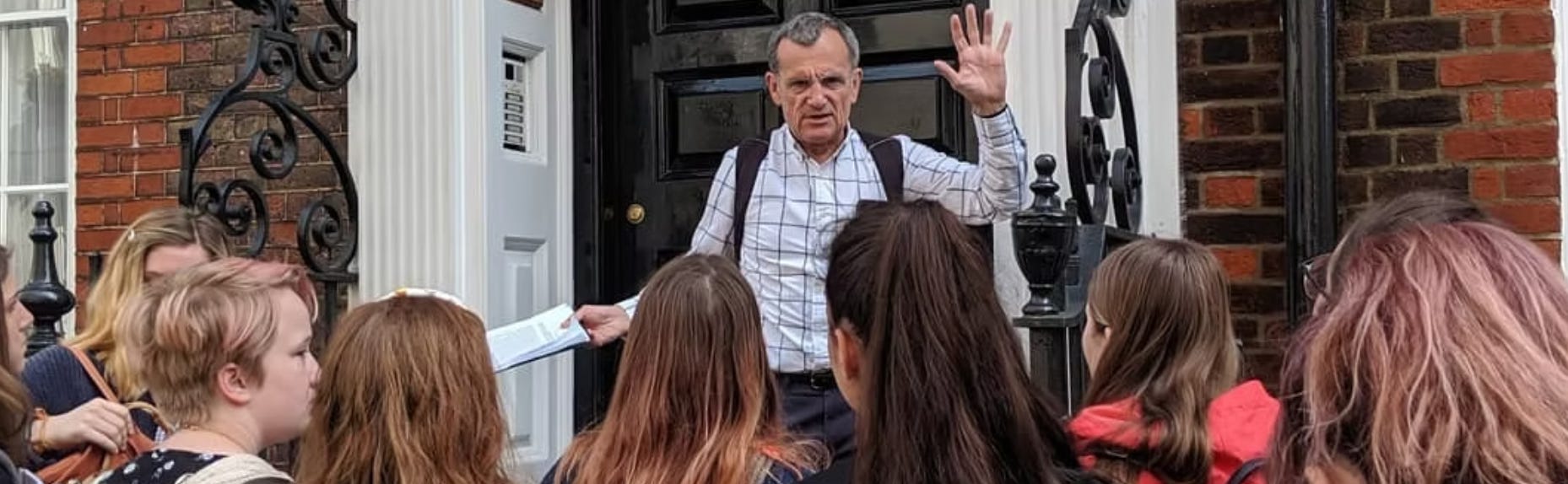
The Former Mayor of Islington, London (and Blue Badge Tour Guide) David Poyser Showing us the Door Knocker That Inspired Scrooge’s Vision of Jacob Marley in A Christmas Carol. Several of These Students Featured This Tour in Their Write-Up of the Study-in-Residence in Their College Applications.
A Study-in-Residence Course Design Example for A Tale of Two Cities.


The Question:
“History” isn’t simply “what happened,” but an active process of constructing the historical record. Even at the time, events are interpreted differently by different people for different reasons. Over time, the historical “memory” is contested by political actors, often to serve their own agendas in the present.
This makes Historical Fiction one of the most popular and important literary genres, as described in these “10 Thoughts on Historical Fiction” by writer M.K. Tod, reviewing Jerome de Groot’s The Historical Novel. When an author asserts that their work is “Based on a True Story” or “Inspired by True Events,” the “truthfulness” of the fictionalization of history is part of its appeal, even if the author simply intended to tell a story.
Inevitably, this leads us to ask how much responsibility the artist has to the historical record of the events portrayed in their fiction. And, more importantly, beyond historical accuracy and the question of “Did that really happen?”, there are the questions of truth and perspective: What is the artist trying to say about the history, and what do we take from this to understand our present?
This is important because our “knowledge” of historical events comes not just from histories, but from books, movies, television, and other works of art. Thus, interpreting artistic works is part of creating the historical record, part of creating the collective memory of “what happened” and “why it matters.”
For our course, it’s fair to say that most Americans only get a broad outline of the French Revolution in school. Rather, we “understand” the French Revolution not from history books, but from works like musical Les Misérables (which isn’t about the original French Revolution!) and the guillotine scenes from Charles Dickens’ A Tale of Two Cities.
So, at the conclusion of our Study-in-Residence, we will answer the following question:
Based on our deep-dive into Charles Dickens’ creation of A Tale of Two Cities, how do we “know” what we think we know about the French Revolution? What can we understand about the nature of history itself?
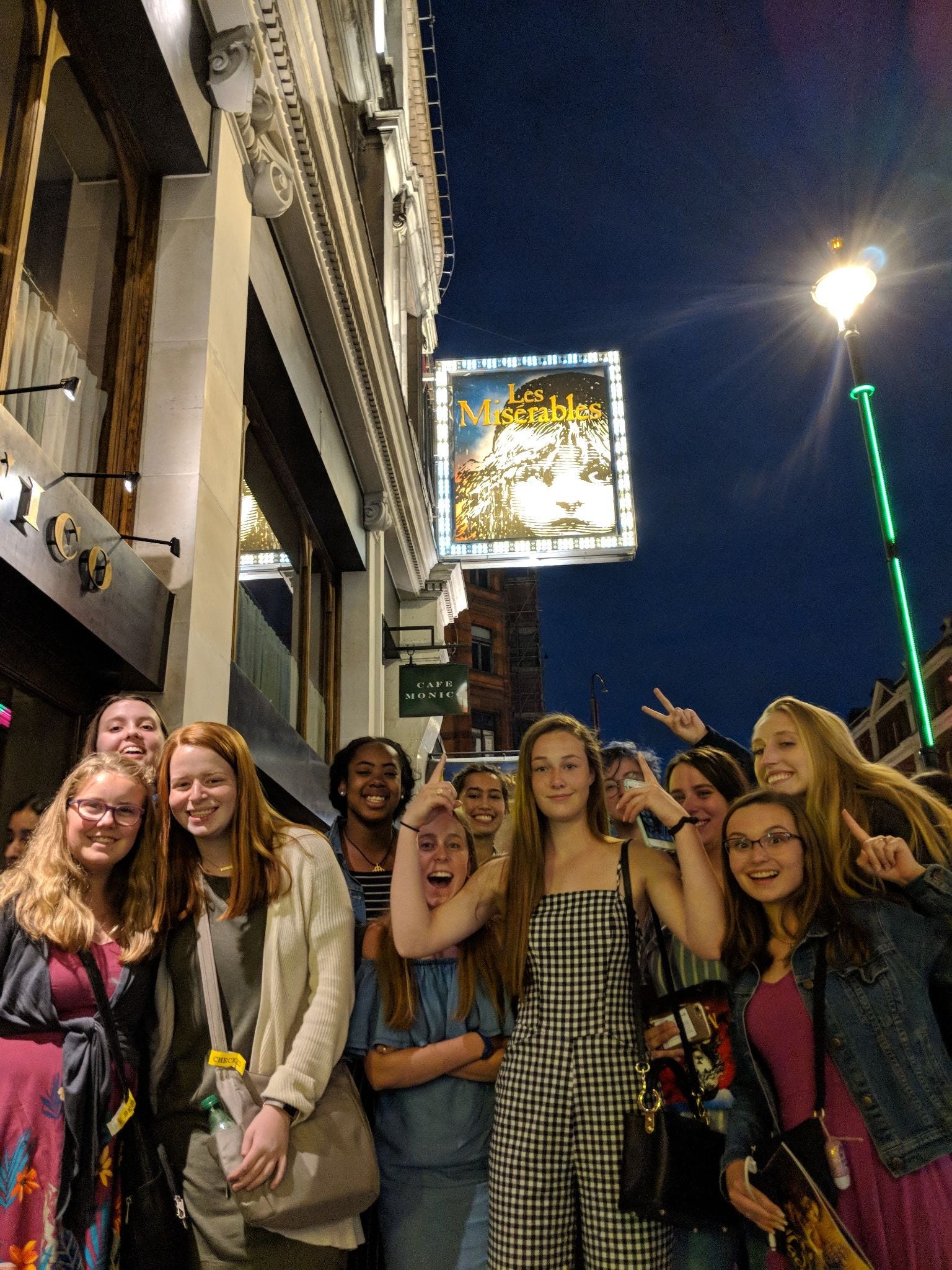
How Do We Know What We Think We Know About the French Revolution? Mostly, By Going to Shows like Les Misérables! This is Why Understanding Where Les Misérables Came From Is Important
The Readings:
During this course, we will trace:
Artifacts and contemporaneous accounts of the French Revolution in Paris
How the history of the French Revolution was written, both in France and England
How Dickens fictionalized that history in a historical novel
How those historical details are used to adapt the French Revolution into plays, musical theater, and movies.
How all these elements combine to create the “Historical Memory”
Before the trip, we will read, of course, A Tale of Two Cities during regular class. During Interim Week, the Study-in-Residence students will read different books and articles to put the book and the history into context, particularly focusing on preparing us for experiences on the trip.
The Syllabus is as follows. We will read all of Claire Tomalin’s Biography of Dickens. For the books, we will read key chapters only. The articles will be provided for you, and the movie will be linked.
Dickens, Charles. A Tale of Two Cities. Norton Critical Edition, (2019). Contains critical essays and original illustrations from the First Edition.
A Tale of Two Cities. Directed by Ralph Thomas. Pinewood Studios, 1958.
Carlyle, Thomas. The French Revolution: A History. Modern Library Classics, (2002).
Andress, David (Ed.). The Oxford Handbook to the French Revolution. Oxford, (2015).
“The Poor Laws.” In Our Time Podcast, Hosted by Melvyn Bragg, Produced by the BBC (2018).
Grimble, Edward. “Walking Fast and Far: Dickens and Restless Pedstrianism.”
Spurgin, Timothy. “Notoriety is the Thing: Modern Celebrity and Early Dickens.”
Smith, Grahame. “Dickens and the City of Light.”
Litvak, Leon. “Dickens’ Burial as Bodysnatching.”
Scott, Laurence. “Charles Dickens: The Writer Who Saw Lockdown Everywhere.”
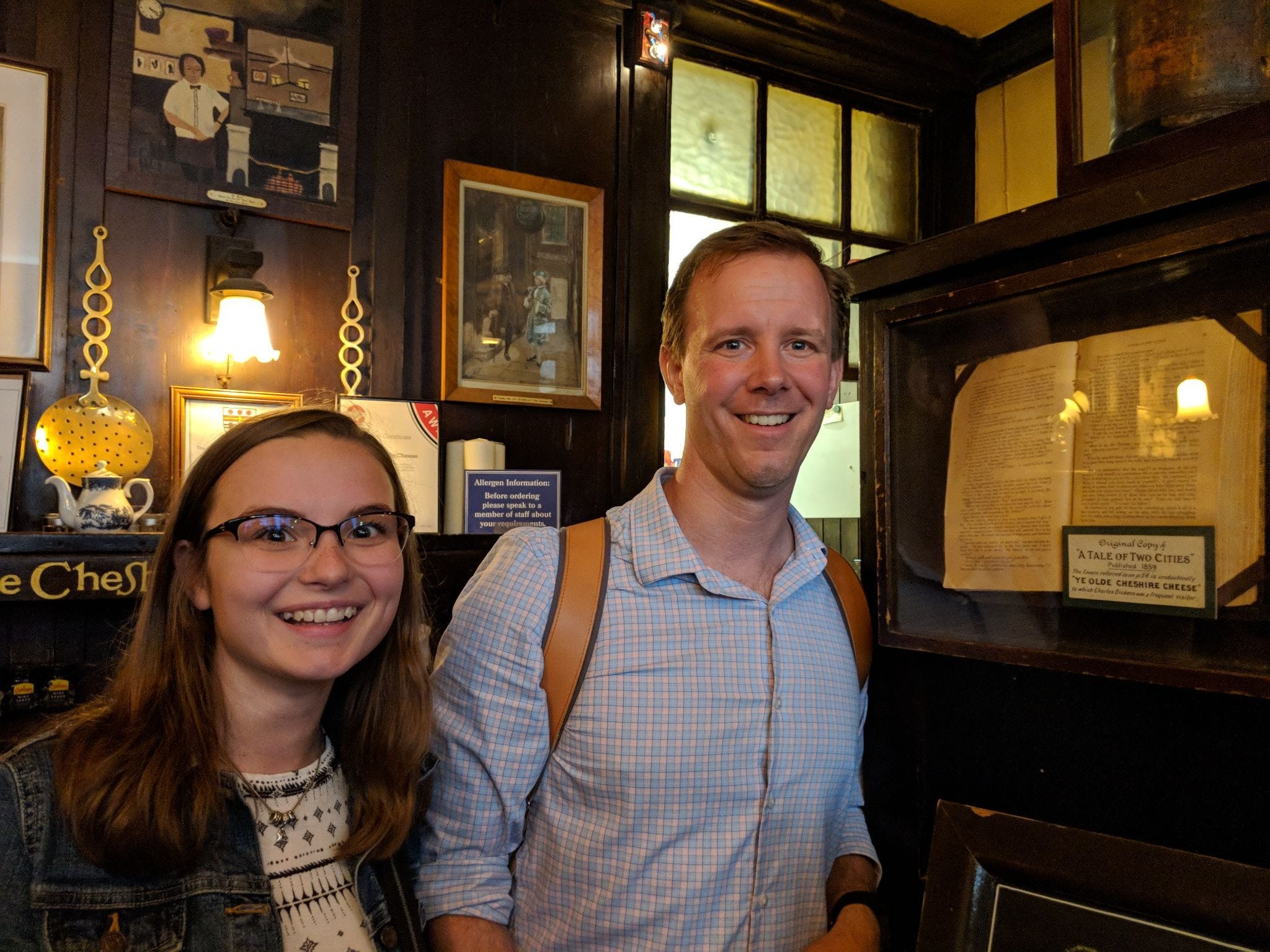
Dr. Himes and Lauren in Front of an Original Edition of A Tale of Two Cities, Opened to the Page Where Dickens Set a Scene in That Very Pub. Lauren and I Performed the Scene in the Underground Dining Hall While Everyone Was Waiting for Lunch
The Journey
We will begin the trip in London for nine days, then take the Eurostar to Paris for four days, traveling home after thirteen days. During each of these learning experiences, we’ll take notes, and at the end of each day, we will meet together at the residence to talk about what we learned. During that time, you’ll journal your experiences–these notes, journals, pictures, and videos will become part of your visual essay at the end of the course.
During that time, we will do the following 60-90 minute walking tours:
“Twists and Turns: A Tour of Oliver Twist’s London”
“The London of A Tale of Two Cities and the Fleet Street that Charles Dickens Knew”
“Westminster Abbey: Dickens’ Burial as a Form of Body Snatching”
“Dickens History Walk: The Debtors Prison that Haunted Dickens”
“The Soho of of Dr. Alexandre and Lucie Manette”
“Highgate Cemetery: Why Dickens Chose This Place to Bury His Wife, His Daughter, and His Parents”
“The French Revolution Along the Seine”
We will also have learning experiences at:
The National Art Library in the Victoria and Albert Museum
The Dickens Museum
The British Library Study Room
Westminster Abbey
The Globe Theatre
Highgate Cemetery
St Pancras Old Church
British Film Library
Les Misérables
Musée Carnavalet
The Pantheon
And, we will enjoy experiences at:
A play at the National Theatre
A play at Shakespeare’s Globe
An opera at Regents Park Outdoor Theatre
A canal ride through London from Camden Docks to Little Venice
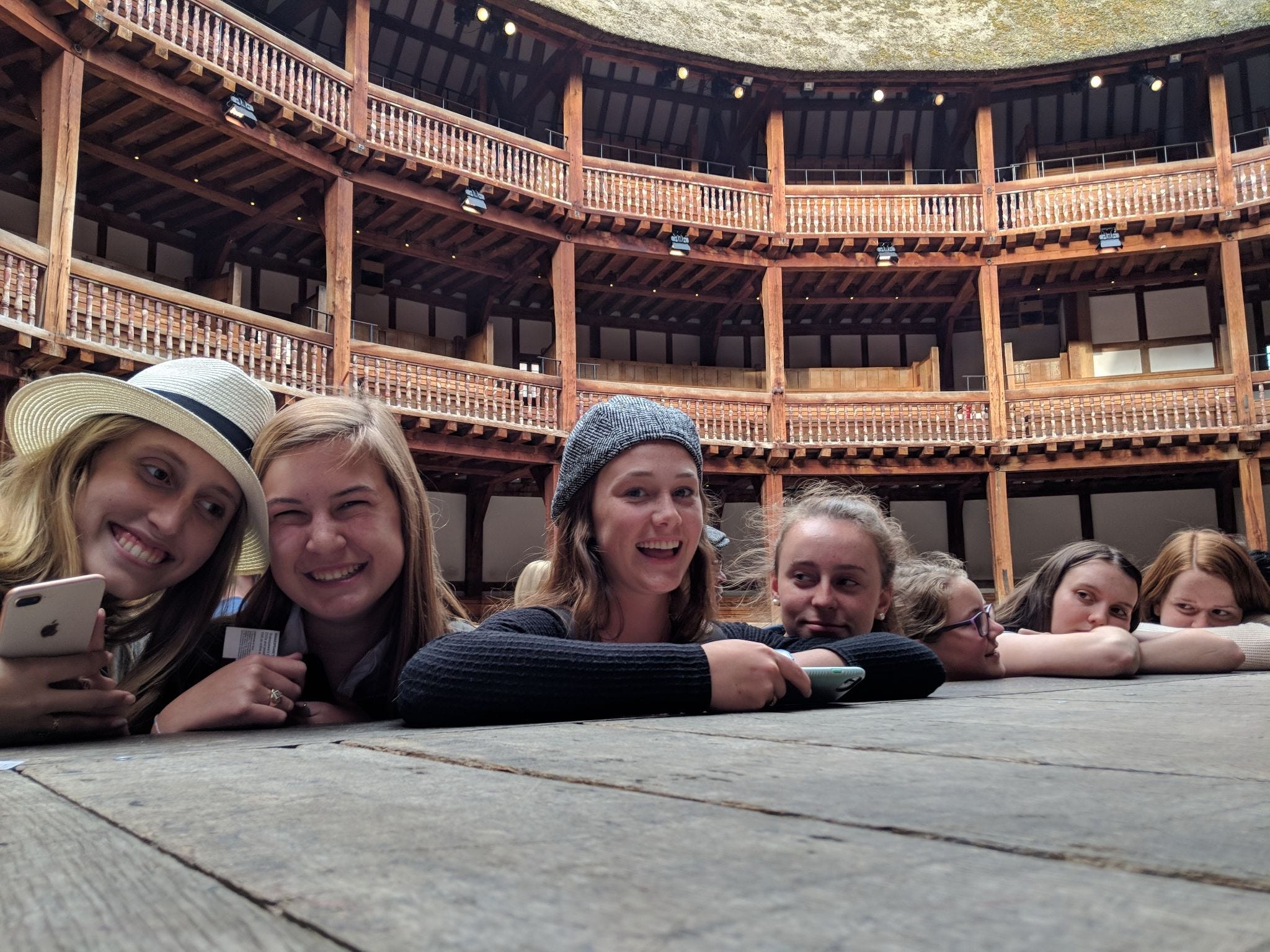
In the Penny Pit Leaning Onto the Stage Before Hamlet at Shakespeare’s Globe
The Return:
Students will create their visual essays using their learnings to answer the Question posed at the beginning of the course: What can we understand about history by deep-diving into Charles Dickens’ writing of A Tale of Two Cities?
In addition, we will put on a Gallery Walk and Reception, where we will come together as a group one last time, with our parents and teachers, to showcase our work and share stories of this adventure.
Beyond that, your visual essays are a great piece for your college admission portfolio. More than just a trip, Study-in-Residence projects show colleges that you have primary and secondary research skills, are able to synthesize enormous amounts of information into your own personal insights, can navigate big cities with a group of your peers, are able to pack and plan--you are ready to study abroad.