


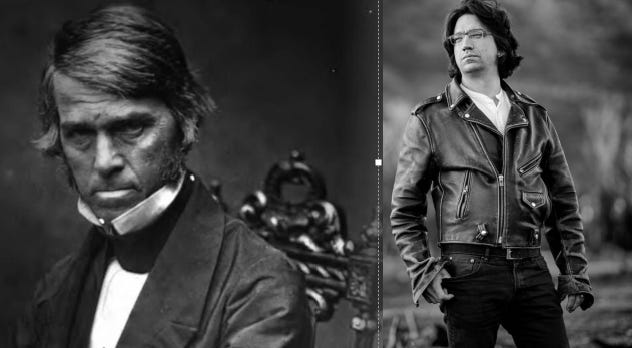
“Rebels” With A Cause: Thomas Carlyle and Curtis Yarvin, Reactionary Monarchists Who Believed They Were Outcasts Because They Spoke Truth to Woke Power, When Actually They Just Costumed Gutter Racism in Intellectual Prose. Also, Whined About Being “Cancelled” Even Though They Never Shut Up and Influenced The Most Powerful People In Culture and Government.
A Tale of Two Cities is the Great Novel for our times, not just because all modern politics is fallout from the collapse of feudalism, symbolized by the Fall of the Bastille.
There is a clear, self-acknowledged lineage from the “House Philosopher” of today’s Techno-Fascist MAGA Movement, Curtis Yarvin, to his intellectual idol Thomas Carlyle, the most influential British philosopher of the 19th Century and the key source for Charles Dickens’ historical fiction of the French Revolution, A Tale of Two Cities.
In his 94-page essay on Thomas Carlyle, Curtis Yarvin plainly states:
I am a Carlylean. I’m a Carlylean more or less the way a Marxist is a Marxist. My worship of Thomas Carlyle, the Victorian Jesus, is no adolescent passion—but the conscious choice a a mature adult. I will always be a Carlylean, just the way a Marxist will always be a Marxist. And it is not too late for you to join us yourself! It’s a big tent, this cult of Carlyle.
Charles Dickens would count himself in this cult of Carlyle as well—but, and this is what makes A Tale of Two Cities so fascinating—Dickens might have worshipped at the Church of Carlyle, but his actual beliefs were quite different. To begin with Carlyle was an atheist, whereas Dickens was quite religious and is most famous for, more or less, inventing Modern Christmas. But more to the point, Carlyle and Dickens had very different views about history—not about what happened, but more about the idea of “history” itself.
Dickens began as a journalist, he never stopped doing journalism, and his habits and methods were that of a journalist. Dickens famously walked the London streets 20 miles a time, hung out in pubs (there are at least a dozen pubs still today that tout “Dickens Was Here”), and would visit prisons, ragged schools, slums—wherever there was a story, Dickens went there, with his notebook, and turned the lives of people into characters. Whatever else we can say about Dickens, he was interested in people. In fact, Charles Dickens’ first published work was Sketches by Boz, a collection of 56 short bits on London scenes and people, written under the pen name “Boz,” which earned him enough clout to begin work on The Pickwick Papers.
Thomas Carlyle, the “Sage of Chelsea",” didn’t really care about people. He was a polymath who inhabited the Life of the Mind. We will talk about him much more later, but Carlyle really didn’t think about, or care for, everyday people. This disposition led him to his most enduring idea: Carlyle’s reaction to the social upheavals caused by the European Potato Famine and the “Hungry 40s” was the Great Man Theory of History, in which history is “made” by the inherently superior men who are unafraid to use overwhelming violence to Restore Order.
The revolutionary period of the 1700-1800’s spawned Liberal Democracy and various forms of Socialism, whose conflicts with Reactionary Conservative Monarchical Dynasties led to Europe’s collapse during World War I. Thus, the Great Hero Who Restores Order became the philosophical underpinning of Nazi politics: According to Goebbels’ diary, in Hitler’s final hours in the Fuhrerbunker, he took comfort in reading Carlyle’s biography of Frederick the Great, which convinced Hitler that he was, indeed, a Great Man of History Restoring Order for the Master Race.
Carlyle’s status as the Nazis’ intellectual godfather is how Yarvin connects the English, American, and French Revolutions to Fascism to MAGA. Yarvin has written that Hitler was a “genius” (but, to be fair, he endorses Hitler’s ideas but not necessarily his methods and aesthetics), then brings that past into the present.
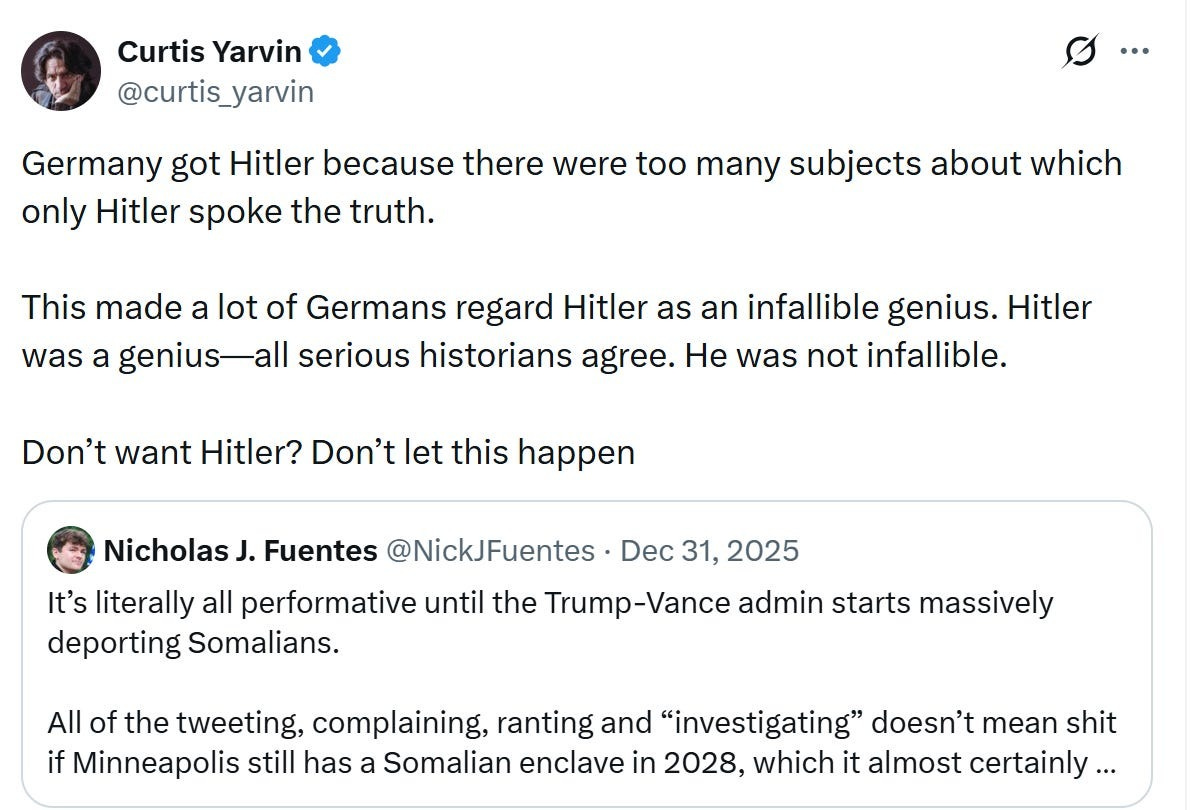
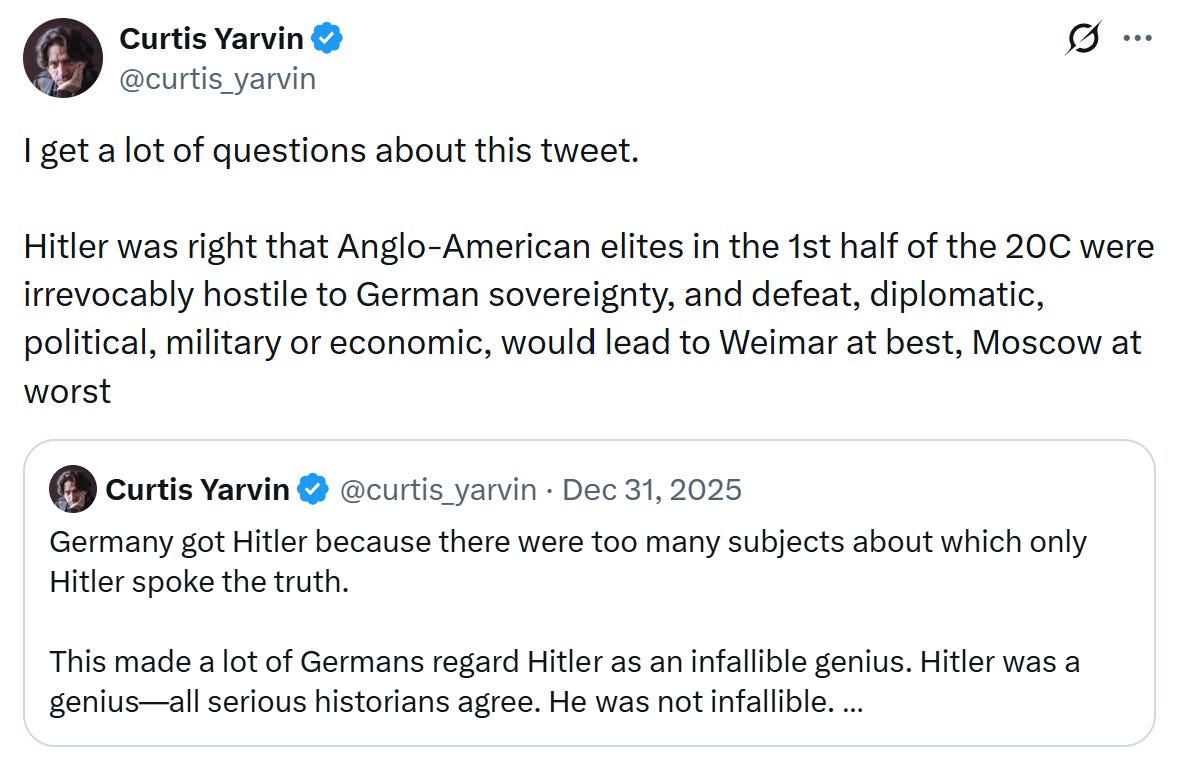
You don’t need to “read into” Yarvin’s writings to connect the Nazis to what ICE is doing in Minnesota: In late December 2025, Yarvin said that “Hitler Spoke The Truth to Germans” and that “all serious historians agree” that Hitler was a “genius,” which justifies self-proclaimed Hitler admirer, Holocaust denier, and Donald Trump dinner guest Nick Fuentes’ call to ethnically cleanse Minnesota of its Somali population.
How MAGA “Thinks” Begins With Dickens’ Source for the French Revolution
So, yes, if you want to understand how MAGA thinks, you have to understand Curtis Yarvin, who “has shaped J.D. Vance’s thinking more” than anyone. And to understand Yarvin, in Yarvin’s own words, then you need to understand Thomas Carlyle’s study of the French Revolution. Much of Yarvin’s thinking evolves from his analysis of the French Revolution, which, in Yarvin’s mind, resulted from Enlightenment French intellectuals getting brain poisoned by the American and English revolutionaries’ revolt against their rightful kings.
Thomas Carlyle was also Charles Dickens’ major literary and intellectual influence, and hisThe French Revolution: A History is Dickens’ is chief source material for A Tale of Two Cities. Dickens and Carlyle were so close that the famously curmudgeonly Carlyle was so impressed by A Christmas Carol that, upon reading it, he immediately went out and bought a turkey. In fact, Dickens’ portrayal of celebratory feasts in A Christmas Carol grew directly from the economic exploitation of the Industrial Revolution and the Hungry 40s: “How Victorians’ Fear of Starvation Created Our Christmas Lore.”
So, when Dickens decided to write an historical fiction of the French Revolution, he asked Carlyle, who founded the London Library with books from his personal collection, for sources. According to Dickens, Carlyle sent “two cartloads of books” to his house–and though there’s a bit of legend here, Carlyle’s influence on A Tale of Two Cities and, thus, the popular memory of the French Revolution, is profound.
But Dickens’ book isn’t just Carlyle’s philosophy in an historical fiction. Rather, the brilliance of Cities is that Dickens begins with Carlyle’s narrative and fashions something entirely his own, and in many ways, deeply contradictory to the thinking of Carlyle: A deep meditation on what it means to be a Christian in a time of state terror.
Dickens opens Cities with the most famous line in literature: “It was the best of times, it was the worst of times.” We will deep dive into this paragraph, but for now, understand that Dickens is saying: No matter how extraordinary the time in which you live–whether 1789, 1859, or 2026–it’s always been like this! In one of Cities’ most literary passages, Dickens describes the boots headed to the Bastille as echoing from Paris to London, and from aristocrats’ crimes in the past to the revolutionaries’ revolt in the present, the repercussions of which we experience in our time and space, which then echoes on to other times in other places.
And so it is with Curtis Yarvin and the philosophy of MAGA: Curtis Yarvin traces his philosophy from the English, American, and French revolutions, idolizing Carlyle as the antidote to all this rabble, then follows the path through Fascism right up to MAGA and the need to ethnically cleanse Somalis from Minnesota.
All of this is why A Tale of Two Cities is the Great Novel to read during the Second Trump Administration: It helps us understand how we got here, what’s happening now, and what we can do about it.
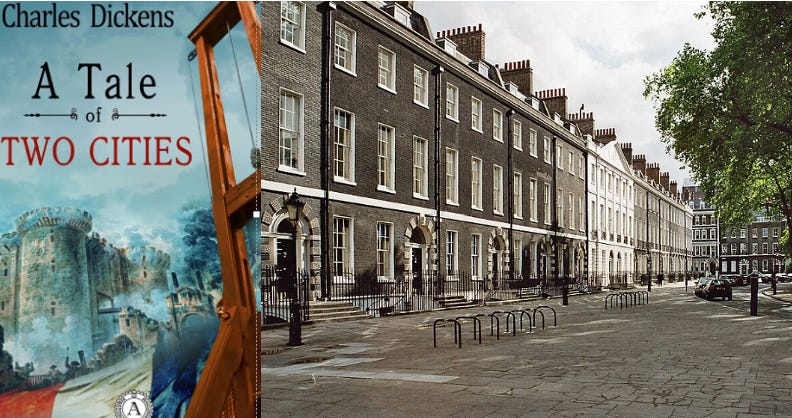
The “Wonderful Corner for Echoes” in Bedford Square, London That Inspired Dickens’ Metaphor for History During the “Storming of the Bastille” Chapter in A Tale of Two Cities.
Who Is Curtis Yarvin?
An intensely boring, predictable pseudo-intellectual, a partially homeschooled student who was told he had a High IQ, which gave him a pathologically overinflated sense of his own intelligence, turning him into one of those reflexively contrarian man-boys who provokes the sheeple who haven’t read, and anyway wouldn’t understand, Thomas Carlyle and Hans-Hermann Hoppe.
You will be shocked to discover that Yarvin’s father was overbearing, his childhood “seems to have left him a lifelong feeling of inadequacy,” and he likes to burnish contrarian bonafides by talking about his Jewish Communist grandparents from Brooklyn rather than his WASP grandparents from Tarrytown. The High Priest of the Far Right lives in Berkeley after having bought a condo in Haight-Ashbury.
So, yes, he’s a self-styled Edgelord who literally created the “Red Pill” meme on his Mencius Moldbug blog. Long story short, he went to Silicon Valley, made some money as a successful software designer, started a “self-directed study of computer science and political theory” (literally doing his own research), and then wrote neo-Monarchist blogposts that caught the attention of Peter Thiel-sphere tech guys and far-right agitators.
Having spent a lot of time reading and reading about Curtis Yarvin, I can report: He is not very interesting, and virtually none of his work holds up to serious scrutiny. But if you want more, his “Unqualified Reservations by Mencius Moldbug” blog is the primary source, and the definitive Yarvin biographical essay is this Ava Kofman New Yorker piece.
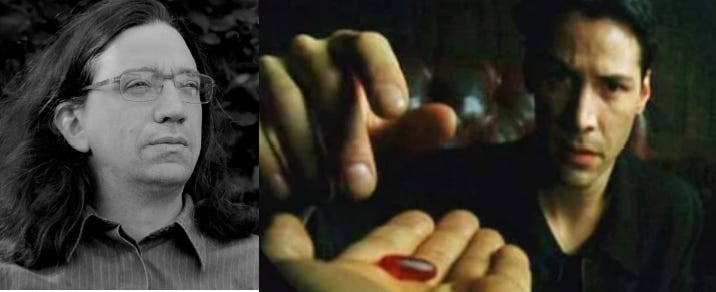
Curtis Yarvin Believes That He Is Giving You The Red Pill By Intellectualizing Racism, But He Really Red-Pilled Himself By Internalizing the Only Praise He Got as a Child: Having a High IQ.
What Does Yarvin Believe?
As far as I can tell, there are three pillars of Yarvin’s “philosophy,” if you can call it that:
Hereditary Monarchy, Scientific Racism, and the Technological Republic.
If you think of these three strands interwoven, like a triple helix, this gets you really close to what’s happening in the Second Trump Administration. It can be hard to follow Yarvin’s meandering, try-hard ahistorical thoughts: Just know that Curtis Yarvin likes to say things like, “Napoleon was a start-up guy,” and that, mostly, he told Silicon Valley Tech Lords, Far-Right Racists, and Incel College Republicans what they wanted to hear.

The Three Pillars of Yarvin: The Monarchy and Aristocratic Court of the Sun King Louis XIV, the Scientific Racism and Colonial Defense of Thomas Carlyle, and the Technological Surveillance State of Peter Thiel.
Hereditary Monarchy
Curtis Yarvin is, at his core, a biological supremacist. He talks a lot about “biological roots of intelligence,” which has influenced J.D. Vance. Translated into an historical analysis, this means, of course, there is a “natural” aristocracy that should be headed by a hereditary monarch. Yarvin’s favorite monarch is Louis XIV, France’s “Sun King” who consolidated the realms of Gaul, creating Versailles as both a literal palace for, and the idea of, a ruling elite. Louis XIV’s governing philosophy is contained in the famous “L’état, c’est moi”: “I am the state.” To Yarvin, in news that would startle the 98% of France who weren’t aristocrats during the 1700s, an absolute monarch would be a benevolent ruler because “ransacking the state holds no meaning because it’s all his anyway.”
Thus, Yarvin believes that the English, American, and French Revolutions were illegitimate. He refers to himself as a “Jacobite,” the self-styled term for restorationists of the Stuart Monarchy of 1603. Why? According Austrian School economist of the Far Right Hans-Hermann Hoppe:
Essentially, revolutions act like cults; they delegitimize everything outside of them. The idea that we live in a kind of cult of the present that delegitimizes the past was somewhat new to me. And when you’re in a cult, it feels like the rest of the world is in a cult.
This is an interesting take, considering that Hoppe and Yarvin are famous today mostly because of the influence of a tiny cabal of Silicon Valley tech billionaires. But, to be fair, Yarvin’s take is also influenced by Thomas Carlyle, who absolutely describes the French Revolution as an insane and dehumanized cult—which is also conveyed by Dickens in A Tale of Two Cities, though, as we will discuss, Dickens has a much more nuanced take on the situation.
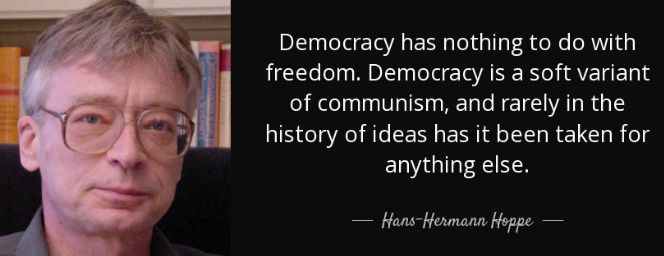
Scientific Racism
All these Far Right guys are IQ-obsessed, genes-determinists who want to legitimize their gutter racism with “science.” Curtis Yarvin was just the smartest-sounding one to publish it on a blog during the Tea Party era anti-Obama backlash.
If you want specifics, this account of his interview with New Labour former communications chair and podcaster Alastair Campbell from the 2024 Let the Light In London Conference is a great shorthand. Here, Curtis Yarvin talks about his “satirical” Mencius Moldbug essay “Race: A Modest Proposal,” modelled on the famous Jonathan Swift satire. Yarvin proposes mandatory DNA tests before filling out the census, that kind of thing.
I put “satire” in quotations because it’s clear that Yarvin isn’t really kidding. He believes deeply in hereditary aristocracy headed by a hereditary monarch. When you combine this with his well-documented love of using the n-slur, this represents his true beliefs:
Race, of course, is hereditary by definition… Transferable titles of hereditary nobility will end up in the hands of those most capable – a reality confirmed again and again by 21st Century science.
This excerpt from Ava Kofman’s New Yorker profile tells us what he said, on the record, about “ghetto Blacks,” which represents most of what you read on Mencius Moldbug:
I’d been pressing him on how he would define success in the second Trump Administration. Answering himself, he said that the “obvious solution” to problems of inner-city drug abuse and poverty would be to “put the church Blacks in charge of the ghetto Blacks.”
And:
“Unless we can totally reëngineer DNA to change what a human being is, there are many people who should not live in a modern way but in a traditional way,” he concluded.
If I were being ungenerous, I would say that Yarvin’s “Race: A Modest Proposal” is a direct rip-off of…Thomas Carlyle’s “satirical” piece “Occasional Discourse on the Negro Question,” which originally used the Hard-R, and is definitely one of the most racist essays from the very racist Victorian era. Carlyle wrote this fake interview with “Phelin M’Quirk” to provoke debate with his intellectual rival John Stuart Mill, where he hides behind the satire facade to argue that obviously unintelligent and weird looking Black people should be enslaved in the West Indies to improve their condition, conditions on slave ships were exaggerated, and on and on.
As we will talk about, Carlyle’s supposed “satire” turned out to be…exactly what he thinks, which he exposed as chair of the Eyre Defence Fund, an organization that raised money to defend Governor Edward John Eyre’s declaration of martial law in the Morant Bay Rebellion, resulting in a charge of “mass murder” for the slaughter and systematic execution of over 400 Black men and women in Jamaica after the abolition of slavery.
(By the way, Dickens also supported Eyre. We will get to all that).
As with his idol Carlyle, it seems obvious that Yarvin hid his real thoughts behind a satire that he knew was unpalatable. But that was 2010, today he’s saying it out in the open:
Whatever the exact solution, he has written, it is crucial to find “a humane alternative to genocide,” an outcome that “achieves the same result as mass murder (the removal of undesirable elements from society) but without any of the moral stigma.”
And, wouldn’t you know it, in his defense of colonialism at the Let the Light In London Conference, Yarvin cites…Governor Eyre as a “good ruler.” “The Third World is a world crying out to be ruled,” he says, mock-proposing a more “efficient” way of doing Apartheid in South Africa: Disenfranchising anyone with an IQ of “less than 120.”
Or, to cross the strands of Hereditary Monarchy and Scientific Racism:
Since racial equality is a myth, democracy cannot work: ‘If negroes are unsuited for representative government, the fault lies entirely with the latter…’
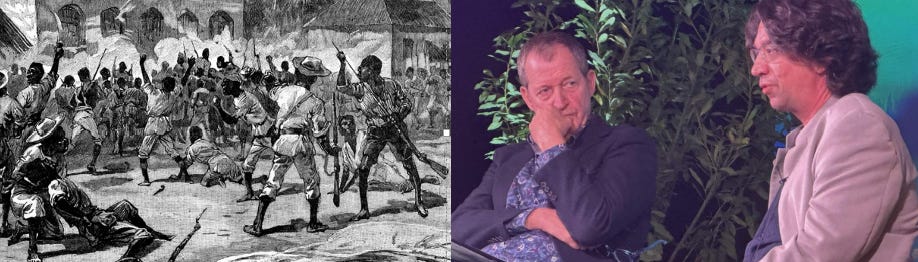
The Morant Bay Rebellion by William Heysham Overend (1865), and Curtis Yarvin Telling Alastair Campbell That Governor Eyre Maybe Didn’t Go Far Enough (2024).
The Technological Republic
So, if you have a hereditary monarchy that rules over the genetic inferiors, how do you keep everybody in their proper place?
The Technological Surveillance State. Or, as Palantir CEO and confirmed techno-fascist Alexander Karp titled his Yarvin-inspired book, The Technological Republic.
This is where Yarvin brings Carlylean thought into the internet age.
Luke Munn’s article in The Conversation is a succinct, precise description of how Curtis Yarvin imagined the “Technological Fascism” of the Second Trump Administration. It is worth reading in full.
Back in 2012, Curtis Yarvin created a blueprint for “How to Reboot the US Government.” First, retire or fire as many government employees as you can, except for the police and military. Seize government funds and direct them toward the surveillance and police state, Defund universities and all scientific research. Ignore the courts, and co-opt if not outright purchase press outlets. Then, shut down elections because “Democracy was beta tested and failed to deliver.” Now, “The political operating system must be ripped out and replaced.”
Yes, you read that right: Curtis Yarvin proposed something like DOGE during the first Obama term.
What do you replace the “operating system of democracy” with?
The “Technological Republic.”
Hugely influenced by Yarvin during the Mencius Moldbug days, Karp argues that an efficient, well-run republic should do away with elections, and be based on “a founder culture that came from tech.” Or, as Yarvin puts it, “A government is just a corporation that owns a country.” Or, as the DOGEfather Elon Musk put it, “the government is simply the largest corporation.”
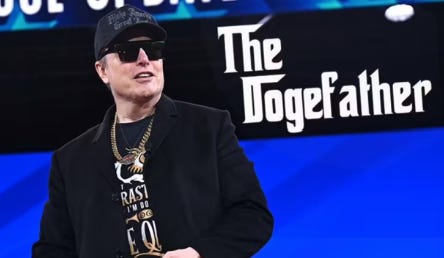
Curtis Yarvin Wrote the Blue Print for This in 2012
Once you rid the republic of democracy, instead of a king, the elites appoint the country’s CEO. The CEO would dismantle what Yarvin calls “The Cathedral”: all the education, humanitarian, religious, journalism, academic, and other “woke” institutions that promote such niceties as civil rights, equal opportunity, that stuff.
This opens up the space for the fascistic Technological Republic: Merge tech firms in the new government structure to conduct mass surveillance, replace workers with AI–basically turn the entire society into the Digital Panopticon where our betters watch over the plebes to ensure the smooth administration of society.
So, all of the OpenAI, Palantir, Elon Musk’s companies–all of these Silicon Valley data farming, collection, and analysis companies are part of the plan. This is how you actually administer a Thomas Carlyle-inspired hereditary monarchy based on scientific racism in the sprawling digital age: Terror through technology
All of this is what Curtis Yarvin imagined in his Mencius Moldbug blog while Trump was still a registered Democrat. All of this Techno-Fascist MAGA Movement of the Second Trump Administration draws primarily from the philosophy of Thomas Carlyle. Charles Dickens’ primary influence in writing A Tale of Two Cities is Thomas Carlyle, and it’s Charles Dickens who, as we will talk about, contemplates the “cult of Revolution,” the “fear of the uncontrollable masses,” the beginnings of the surveillance state, the first use of state terror explicitly as a political tactic, and how technological change collapsed one form of government and ushered in the next.
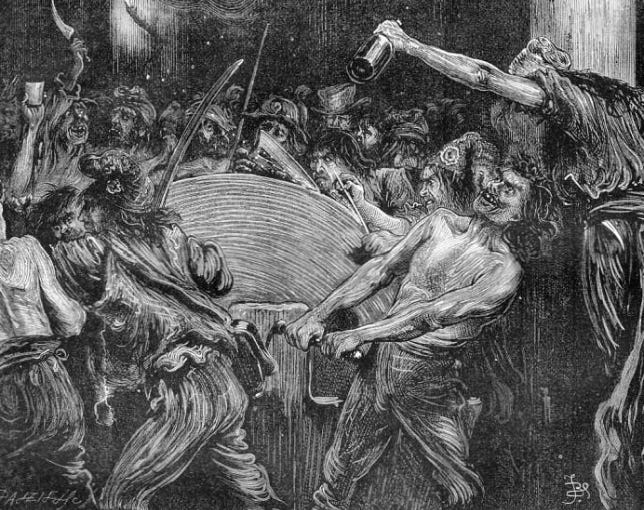

Above: “The Grindstone” by Fred Barnard (1874), Illustration for the Household Edition of A Tale of Two Cities. Below: Palantir CEO Alexander Karp Explaining How the Technological Republic Would Restore Order Through a Digital Version of the Panopticon, Like the Presidio Modelo That Once Held Communist Revolutionary Fidel Castro.
Dickens Would Say That the Best of Times and the Worst of Times Happened Before, Are Here, and Will Come Again
This is not to say that the Yarvin/Thiel/Vance/Trump Techno-Fascist Terror State is an inevitability. In fact, Charles Dickens has something to say about that, which offers an alternative to Carlyle’s proto-fascism. This very image of the turning of the grindstone is how Dickens explains why this will all, eventually, collapse–because it always does, and comes back around again. He gives us a way to think about living through The Worst of Times that is well worth reading in our time. Really, Yarvin himself seems to believe that Dickens’ conclusion will win out in the end, with a sentiment that mirrors Dickens’ philosophy of human nature:
“Unless we can totally reëngineer DNA to change what a human being is, there are many people who should not live in a modern way but in a traditional way,” he concluded. “And that is a level of revolution that is so far beyond anything the Trump-Vance regime is doing.”
Why? Yarvin quotes the French Revolution’s Archangel of Terror, Louis de Saint-Just, who championed the Reign of Terror and makes a brief unnamed appearance in A Tale of Two Cities:
“He who makes half a revolution digs his own grave.”
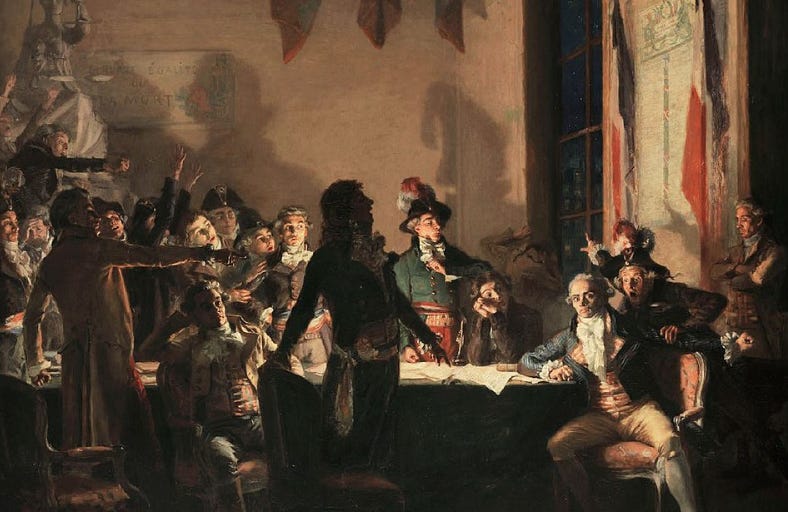
Louis de Saint Just and Robespierre at the Hotel de Ville, Jean-Joseph Weerts (1897), Depicting the Two Architects of the Reign of Terror The Night Before They Were Guillotined by the Thermidorian Reaction, Which Attempted to Restore Order to the Chaotic Republic.

Curtis Yarvin, If You Asked Him How to Deal With Revolutionaries: “The point is, ladies and gentlemen, that guillotines–for lack of a better word–are good. Guillotines are right. Guillotines work. Guillotines clarify, cut through, and capture the essence of the revolutionary spirit.”